
An MLM software company in Tokyo provides the platform a Japanese direct selling business runs on: distributor registration, a genealogy tree, product orders, commission calculation and payouts in yen. What sets a Tokyo project apart is the detail Japan expects, from a natural Japanese-language back office to records that support the written-document and cooling-off rules of the Act on Specified Commercial Transactions.
Direct answer: MLMSoftwareCompany.in builds custom MLM software for binary, level, matrix, unilevel, generation, autopool, ROI and investment plans, with multi-language back offices, yen and multi-currency wallets, e-commerce and audit-ready reports. We work with direct selling businesses in Tokyo, across Japan and worldwide, and all planning and demos happen online. To see your compensation plan running on real screens, book a free demo on WhatsApp.
Key takeaways
- Japan is the sixth-largest direct selling market, with about US$9.6 billion in 2024 retail sales and more than two million independent sellers, according to the WFDSA Global Statistics report.
- Japanese law calls MLM "multilevel marketing transactions" (rensa hanbai torihiki) and regulates them under the Act on Specified Commercial Transactions.
- Your MLM software in Tokyo should store contract-document delivery dates and cooling-off requests, not just orders and commissions.
- Payment options matter: credit cards, convenience-store (konbini) payments and bank transfers are all common in Japan.
- Unilevel and generation plans suit Japan's repeat-purchase wellness and skincare products well; binary is popular with teams that build fast.
What makes MLM software for Tokyo different?
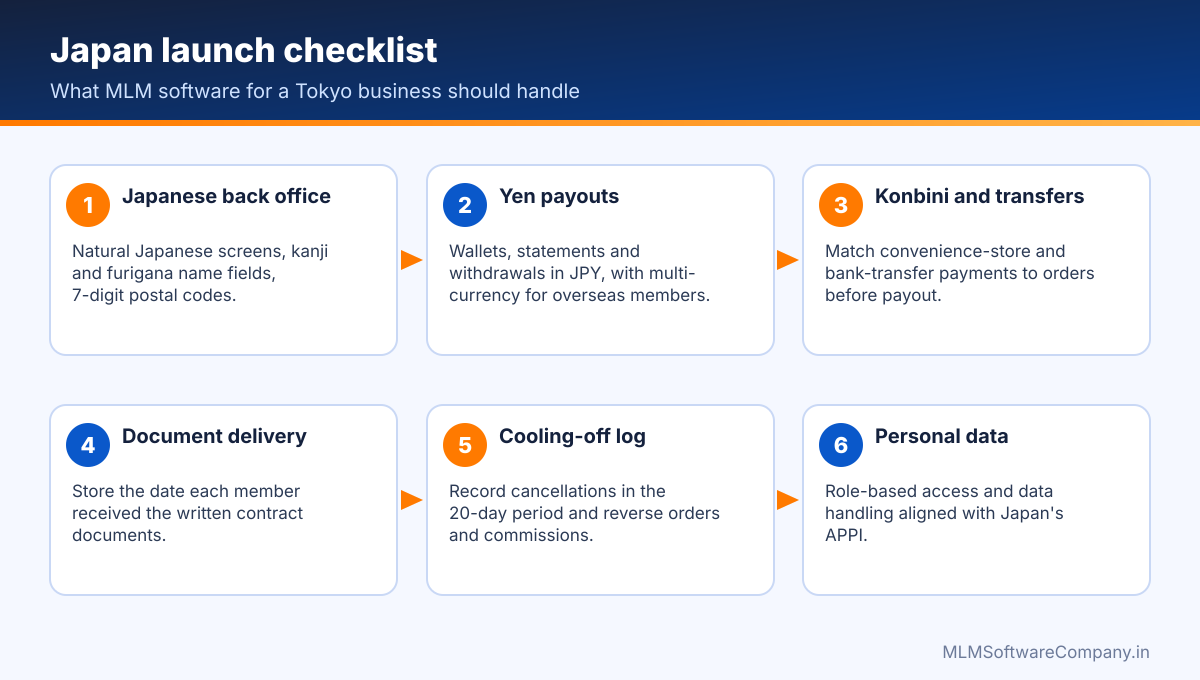
Most MLM platforms are built for English first and translated later, and that is the first thing to test when you compare any MLM software company in Tokyo. Tokyo distributors expect a back office written in natural Japanese, names stored in kanji and katakana (furigana) fields, postal codes in the 7-digit Japanese format, and dates shown year-month-day. Commission statements need to be clear enough that a member can check them line by line, because trust is everything in Japanese network selling.
Tokyo brands often sell skincare, supplements, water purifiers and household goods through long-standing distributor groups. Many members order every month, so autoship, point balances and loyalty discounts are everyday features rather than extras. Payments are also distinct: alongside credit cards, many buyers pay at a konbini counter or by bank transfer, and the software must match those deferred payments to orders before commissions are released. Any MLM software developer in Tokyo you consider should be able to show these flows working, and a serious MLM software development company in Tokyo should treat them as standard. For a wider view, see our MLM software services across Japan.
Which MLM plan suits a Tokyo business?
The right plan is the one your distributors can explain in a single conversation and that pays mainly on product sales. Below, each of the eight plans is described with what the software must do for it, followed by a comparison table.
Binary Plan MLM Software Company in Tokyo
A binary plan gives each member two legs, left and right, and pays on matched sales volume between them. New members placed below a full front line spill into the next open position, so uplines can help newer members grow. The software has to apply placement rules, calculate the weaker-leg match, carry unmatched volume forward and enforce any weekly cap you set. In Japan, where distributor groups often stay together for years, binary trees can grow very deep, so database performance and clear tree views matter. Members should be able to search their own downline by name in Japanese script and see each leg's volume in yen. Our binary MLM software guide explains the matching in more detail.
Level Plan MLM Software Company in Tokyo
A level plan pays a set percentage on purchases made a fixed number of levels below each member, for example five levels deep. It is the easiest plan to explain, which helps with older members who prefer simple rules. The software calculates each level on every order, applies monthly activity requirements and shows members a statement by level. Admins should be able to adjust rates and depth from a settings screen and test the change on last month's data before it goes live. Level plans fit Tokyo businesses with a narrow product range and steady monthly orders. More options are listed on our MLM plan services page.
Matrix Plan MLM Software Company in Tokyo
A matrix plan limits how many people sit on each member's front line, such as 3x3 or 3x7, and spills extra members down to the next open position. This creates a shared, team-style structure that many Japanese groups like. The software must place members in a predictable order, show open and filled positions, and calculate commission on each level of the matrix. If your plan "cycles" a completed matrix, the system has to close it and open a new one automatically. You can read more in why a matrix MLM software matters.
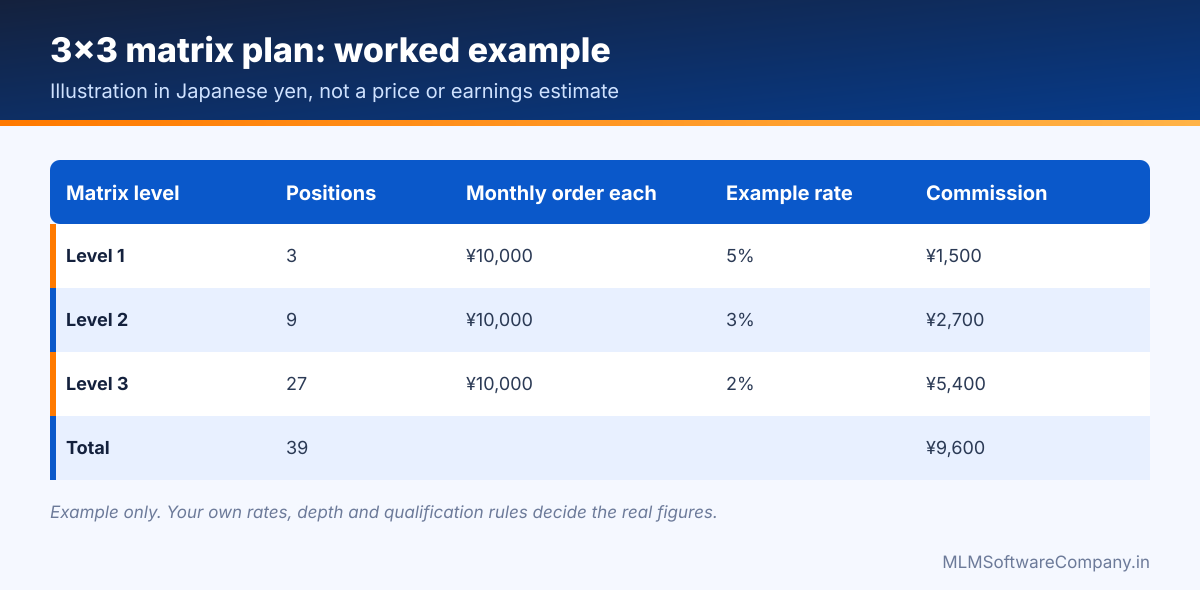
Worked example (illustration only, not a price or earnings estimate): in a 3x3 matrix where each position represents a ¥10,000 monthly product order, a member's matrix holds 3 positions on level 1, 9 on level 2 and 27 on level 3. With example rates of 5%, 3% and 2%, a full matrix produces ¥1,500 + ¥2,700 + ¥5,400 = ¥9,600 in commission for that month.
Unilevel Plan MLM Software Company in Tokyo
In a unilevel plan, everyone a member personally introduces sits on their first level, with no width limit, and commission is paid a set number of levels deep. It suits Japan's repeat-purchase product categories because it rewards steady monthly orders from a wide customer base. Good unilevel software adds compression, which skips inactive members so active ones are paid on the next qualified level, and rank-based depth. It should also separate member self-purchases from purchases by registered customers, which helps when reviewing whether income comes from real product demand. See our unilevel software article.
Generation Plan MLM Software Company in Tokyo
A generation plan pays leaders on the sales of successive "generations" of other leaders below them. A generation ends each time the software finds a member at or above a set rank, and the next generation starts below that person. Tokyo distributor groups are often organised around long-serving leaders, so a generation bonus is a natural way to reward them. The software must recalculate generations when ranks change and present each generation's volume clearly on the leader's statement. For example (illustration only), a leader could receive 3% of a first generation's ¥2,000,000 monthly volume (¥60,000) and 2% of a second generation's ¥1,500,000 (¥30,000). Generation plans are usually added on top of a unilevel base; see our services for hybrid plans.
Autopool Plan MLM Software Company in Tokyo
An autopool plan places members into shared pools in the order they qualify, filling each small matrix automatically instead of by sponsor. When a pool fills, the member at the top completes it and may move up to the next pool. The software has to keep a tamper-proof queue, show each member's position and record every pool movement. In Japan, any structure where joining or moving up depends on paying money rather than on product sales can fall foul of consumer law, so pool entry should be tied to genuine product purchases and checked by a Japanese lawyer before launch. Autopool settings are covered on our services page.
ROI Plan MLM Software Company in Tokyo
An ROI plan module calculates scheduled credits to member wallets based on rules the business defines, and logs each calculation for audit. MLMSoftwareCompany.in builds the software only; we do not promote or promise any return, and no rate in a configuration should be read as an offer.
Compliance note: the client is responsible for making sure its compensation plan complies with Japan's direct selling, anti-pyramid, securities and consumer-protection laws, including the Act on Specified Commercial Transactions and the Act on the Prevention of Endless Chain Schemes (mugen rensa ko). ROI and investment-style plans and token sales can fall under financial regulation in many countries, including the Financial Instruments and Exchange Act in Japan, so get local legal advice before launch.
Investment Plan MLM Software Company in Tokyo
An investment plan module tracks packages, lock-in periods, credits and withdrawal approvals in a single ledger, with reports for the finance team. The same compliance note applies, and the legal risk is higher still: paying members for buying a package rather than for selling products to customers can be treated as a financial product or a prohibited scheme. We describe and build software features only and never promise income or returns. Tokyo businesses usually get a safer, easier-to-explain structure from a product-based unilevel or generation plan.
Compare the plans side by side
| Plan | How it pays | Typical fit in Japan |
|---|---|---|
| Binary | % of weaker leg's matched volume | Fast-growing teams |
| Level | Fixed % per level | Small catalogues, simple rules |
| Matrix | Fixed width and depth, spillover | Team-style groups |
| Unilevel | % per level, unlimited width | Monthly skincare and wellness orders |
| Generation | % per leadership generation | Rewarding long-serving leaders |
| Autopool | System-filled shared pools | Only with product-based entry |
| ROI / Investment | Rule-based credits | Only after legal review |
Is MLM software legal to use in Japan?
Yes. Using software to run a lawful multilevel marketing business is legal; the law regulates the business and how it recruits and sells. Under the Act on Specified Commercial Transactions, overseen by the Consumer Affairs Agency, sellers must give prospective members written documents describing the transaction, avoid misleading statements, and allow a 20-day cooling-off period for multilevel marketing contracts. Your software can support this by storing when documents were delivered, logging cooling-off and cancellation requests, and reversing commissions on cancelled orders. It cannot replace advice from a Japanese lawyer on your specific plan.
How much does MLM software cost in Tokyo?
Cost is set by scope, not by city. The biggest factors for a Tokyo project are:
- the compensation plan and any hybrid bonuses;
- full Japanese localisation, plus English or other languages for overseas members;
- payment integrations such as cards, konbini payment and bank transfer matching;
- compliance records (document delivery, cooling-off, cancellations);
- mobile apps, custom reports and ongoing support.
The quickest way to get an exact quote is a free demo on WhatsApp: share your plan, and we scope it with you. You can also look at our pricing section.
How to choose the best MLM software company in Tokyo
Choose the MLM software company in Tokyo or overseas provider that can demonstrate your own plan, in Japanese, with yen figures, before you commit. Check these points:
- Is the Japanese interface written naturally, not machine-translated?
- Can every commission line be traced back to an order and a payment?
- Does the system log document delivery and cooling-off requests?
- How are konbini and bank-transfer payments matched to orders?
- Who owns the source code and data, and where is data hosted?
- How is personal data protected under Japan's Act on the Protection of Personal Information (APPI)?
Our guide to choosing the right MLM software company expands on each point. If your group also sells in Korea or Southeast Asia, compare the Penang MLM software guide.
How long does MLM software setup take?
Timing depends on customisation. A standard plan with Japanese branding and card payments is quicker than a hybrid plan with konbini integration, compliance logs and apps. Writing down your compensation rules precisely before development, then testing them on sample data, is the step that saves the most time. You get a project timeline after the free demo.
Crypto MLM and blockchain services in Tokyo
For businesses exploring tokens or smart-contract payouts, we also build crypto MLM and blockchain platforms; see our crypto MLM services and the crypto MLM guide for Seoul.
Frequently asked questions
How do I find an MLM software company near me in Tokyo?
MLM software is planned, built and supported online, so the provider does not need to be in your ward. Look for one that can demo your plan in Japanese and give you a written scope. You can book a free demo on WhatsApp or call +91 9953119957.
What does MLM software cost for a Tokyo business?
The price depends on your plan, the level of Japanese localisation, payment integrations such as konbini payments, and any apps or custom reports. Share your plan in a free WhatsApp demo to get an exact quote.
What should I look for in the best MLM software company in Tokyo?
Look for natural Japanese screens, commission statements you can trace to orders, records for document delivery and cooling-off, support for konbini and bank-transfer payments, and clear ownership of code and data.
How can I get a free MLM software demo in Tokyo?
Message us on WhatsApp, share your plan and products, and we arrange a live demo online. There is no obligation.
Can the software handle the 20-day cooling-off period?
Yes. The system can record when each member received the contract documents, log cancellation requests within the cooling-off period and reverse the related orders and commissions. Your legal adviser should confirm the exact rules for your plan.
Get a free MLM software demo for your Tokyo business
Send us your compensation plan and product list, and we will walk you through the back office, commission run and reports in a live online session. There is no obligation, and you receive a clear scope and quote afterwards.
Get a free demo on WhatsApp (+91 9953119957)
Or call +91 9953119957, or email info@mlmsoftwarecompany.in.